

Turn Forms Into Automated Workflows
Design dynamic forms, streamline operations, and eliminate repetitive manual tasks — all without code.
Talk to Our ExpertsBuild Smarter Forms Faster
Create no-code forms inside Salesforce and automate data collection, approvals, and workflows without complexity.
Get StartedSimplify Your Form Workflows
Replace manual processes with intelligent forms that capture, route, and manage data seamlessly in Salesforce.
Book a DemoHealthcare organizations have been working for years to reduce delays in claim processing, but expectations in 2026 go far beyond simply moving paper forms online. Patients now expect quicker responses, providers want simpler administrative processes, and insurers need accurate information without repeated follow-ups.
This shift is leading healthcare systems toward more intelligent workflows powered by automation, AI, and secure digital experiences. The traditional insurance claim form is gradually becoming a smart system that can collect, validate, and route information in a more organized way, helping teams respond faster.
In this blog, we look at how claim automation is evolving, the technologies supporting it, why modern forms matter, and how organizations can improve processes using better tools.
How Insurance Claim Form Automation Is Shaping the Future of Healthcare
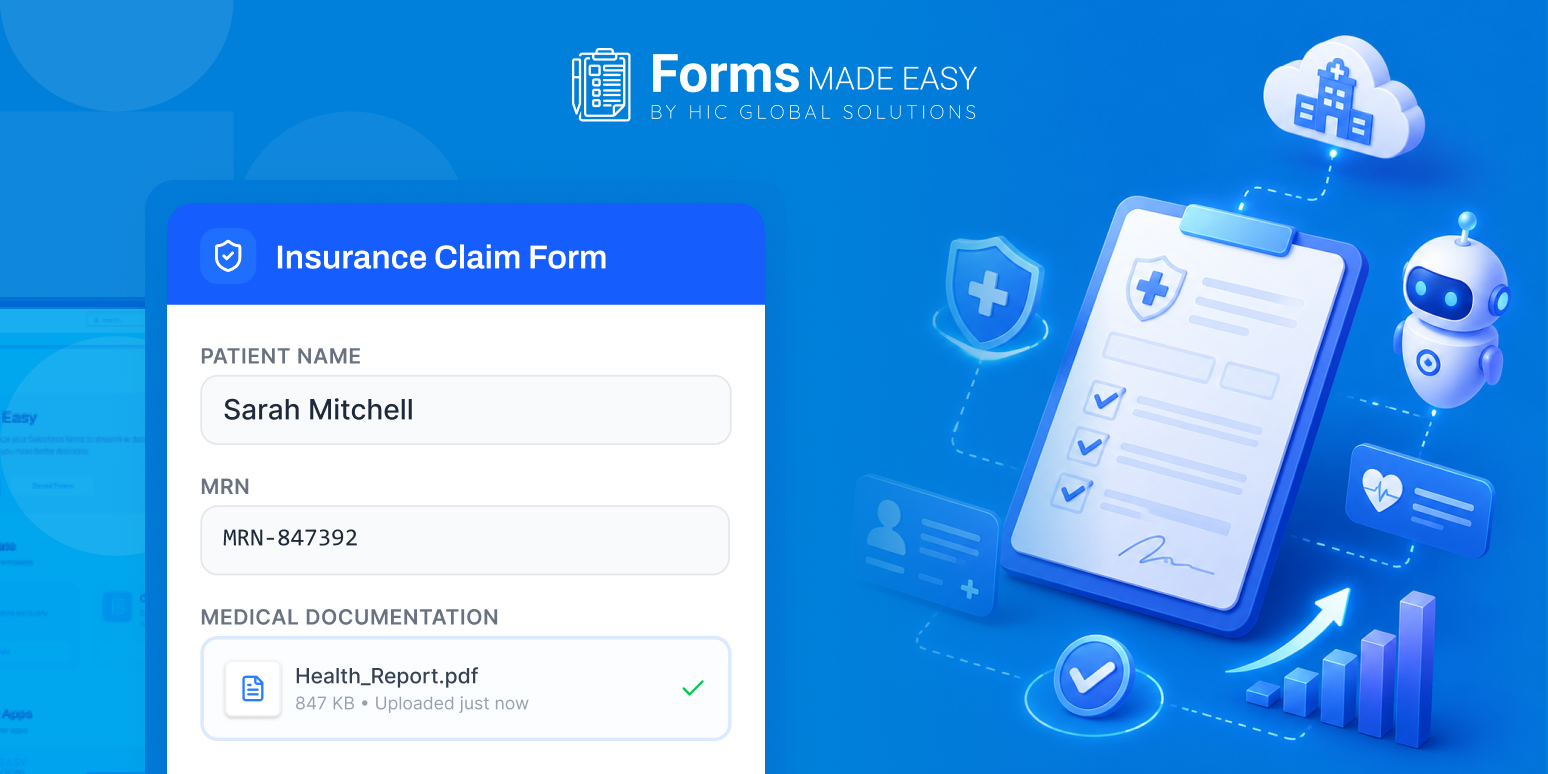
The future of the insurance claim form is not just about replacing paper with digital fields. It is about building smoother experiences that help reduce delays, improve accuracy, and keep the process moving with less manual effort.
Faster Claims Through Intelligent Workflows
Healthcare providers continue to face pressure to speed up claim processing. Missing information, manual checks, and repeated corrections often slow things down for both patients and staff.
Today’s automated insurance claim form systems can help identify missing details before submission and send information to the right teams immediately.
This helps improve:
- Faster claim intake and processing
- Reduced manual data entry
- Fewer errors during submission
- Better visibility of claim status
A well-designed health insurance claim form now works as an early validation step instead of just a data collection form.
Better Experiences for Patients and Providers
Patients today expect healthcare processes to feel simple and clear, similar to other digital services they use. Re-entering the same details or filling long forms can feel repetitive.
Modern healthcare forms offer guided steps that make it easier for users to complete submissions. At the same time, providers receive more complete information, which reduces the need for follow-ups.
This creates a more smooth and consistent experience for everyone involved in the claim process.
Real-Time Data Improves Decision-Making
One of the major improvements in 2026 is real-time data exchange. Instead of waiting for batch updates, organizations can access claim details as they are submitted.
An insurance claim form connected with healthcare systems supports quicker reviews and more timely communication between providers and insurers.
This also allows teams to focus more on patient care and less on tracking updates manually.
Technologies Driving the Next Generation of Insurance Claim Automation
Healthcare automation is growing quickly, and several technologies are changing how claims are processed across systems.
Conversational AI for Guided Claim Experiences
Conversational AI is now being used to make claim submissions simpler. Instead of long static forms, users can be guided step by step through the process.
Patients can ask questions, understand requirements, and complete an insurance claim form with more clarity.
This helps:.
- Reduce incomplete submissions
- Improve data accuracy
- Answer common questions quickly
- Support users throughout the process
Straight-Through Processing (STP)
Straight-through processing allows claims to move from submission to decision with minimal manual steps.
When a health insurance claim form meets required conditions, the system can validate the details and continue processing automatically.
This helps reduce delays and keeps workflows moving more efficiently.
Intelligent Document Processing and OCR
Healthcare organizations often receive supporting documents in different formats. Intelligent document processing and Optical Character Recognition (OCR) help convert these into usable data.
Instead of reviewing everything manually, systems can extract key information from documents linked to a medical claim form.
This reduces processing time and improves accuracy.
Predictive Analytics for Early Risk Detection
Predictive analytics is becoming more useful in claim systems.
By reviewing patterns and historical data, organizations can identify claims that may need closer attention and plan workloads better.
This supports:
- Early identification of unusual claims
- Better resource planning
- Improved operational flow
- More informed decisions
Secure Cloud-Based Integrations
Modern claim systems rely on connected platforms.
Cloud-based integrations allow healthcare forms to connect with EHR systems, payer networks, and internal workflows in a secure way.
This ensures that data collected through an insurance claim form moves safely between systems while staying consistent.
Why Modern Form Technology Matters More Than Ever
Digital systems in healthcare are becoming essential. Claim processes that depend on manual steps often struggle to keep up with current expectations.
Organizations now need form experiences that do more than just collect information. A modern insurance claim form template should support accuracy, compliance, and smoother workflows.
Healthcare teams are focusing more on features like:
- Mobile-friendly form access
- Smart conditional logic
- Secure document uploads
- Automated routing and alerts
- Integration with existing systems
A well-structured health insurance claim form can improve efficiency and make the process easier for both patients and staff.
Security is also a key part of this shift. Since sensitive health information is involved, a HIPAA compliant form is important to keep data protected throughout the process.
Using a HIPAA compliant form builder helps teams create secure and simple workflows while staying aligned with compliance needs.
Forms Made Easy: Simplifying Claim Processes for Healthcare Teams
As healthcare organizations continue to modernize, there is a growing need for tools that are simple, flexible, and secure.
Forms Made Easy helps teams create and manage healthcare forms without requiring complex development work. Whether it is an insurance claim form template, intake process, or supporting documentation flow, it supports smoother digital adoption.
With Forms Made Easy, healthcare teams can:
- Drag and drop fields to create healthcare forms easily
- Add form rules using conditional logic for smarter workflows
- Use prebuilt templates that are ready to use
- Customize the form to match your branding
- Share forms easily or embed them in a website
- All form submissions are saved directly in Salesforce as a native experience.
Organizations managing a medical claim form process can simplify submissions while keeping everything organized and consistent.
Teams looking to improve their claim process can also book a call to explore how Forms Made Easy supports healthcare workflows.
Conclusion
The future of the insurance claim form is focused on speed, accuracy, security, and a simpler experience for both patients and providers. Technologies like conversational AI, straight-through processing, intelligent document processing, predictive analytics, and cloud integrations are changing how claims move through systems.
At the same time, secure and flexible healthcare forms are becoming a key part of this transformation. Using a HIPAA compliant form approach helps organizations protect sensitive data while keeping processes smooth and reliable.
As healthcare automation continues to grow in 2026, organizations that adopt better claim systems will be better positioned to improve efficiency and deliver a smoother experience for everyone involved.