


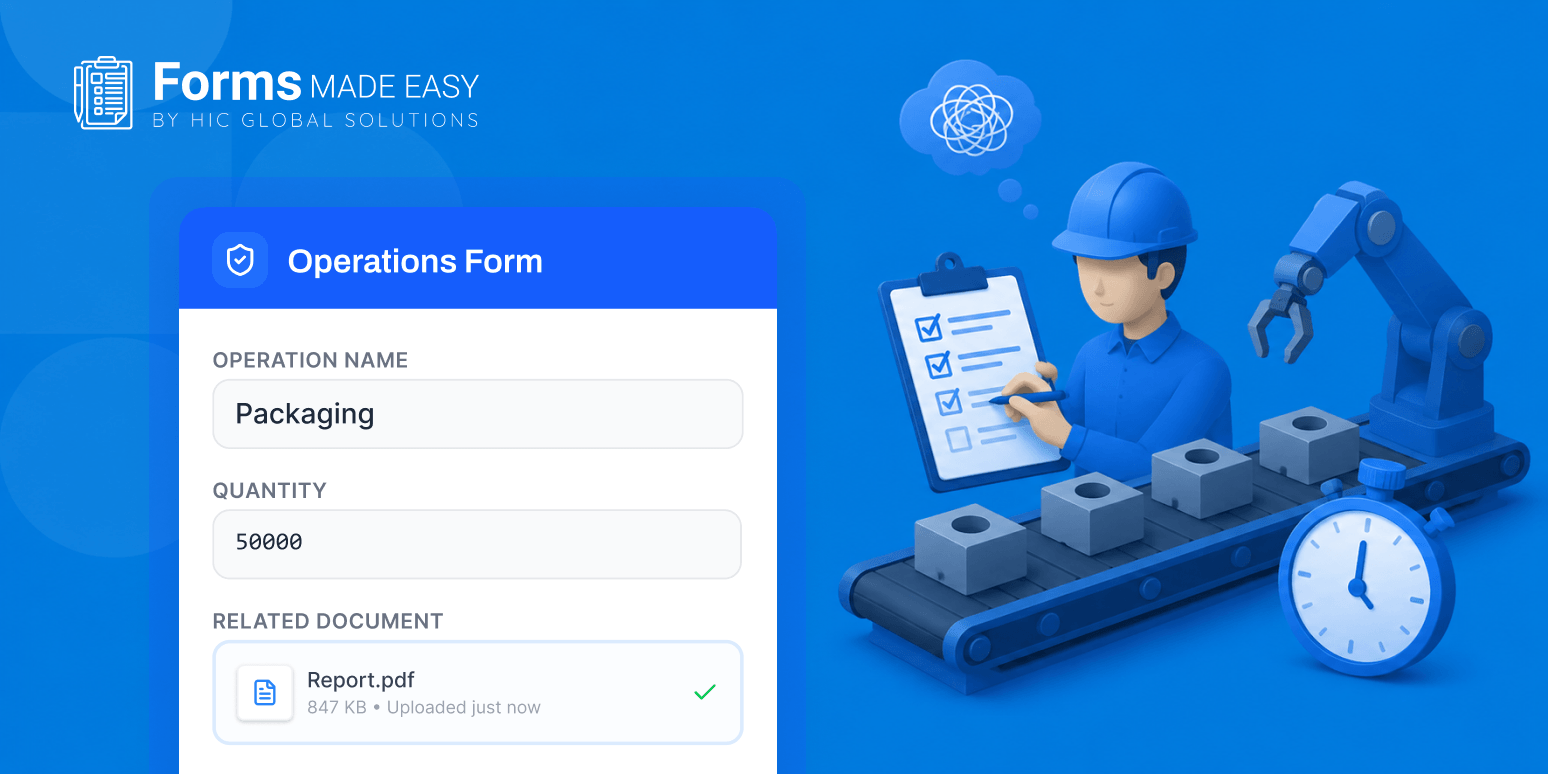
Turn Forms Into Automated Workflows
Design dynamic forms, streamline operations, and eliminate repetitive manual tasks — all without code.
Talk to Our ExpertsBuild Smarter Forms Faster
Create no-code forms inside Salesforce and automate data collection, approvals, and workflows without complexity.
Get StartedSimplify Your Form Workflows
Replace manual processes with intelligent forms that capture, route, and manage data seamlessly in Salesforce.
Book a DemoManufacturing has changed dramatically over the last decade. Production lines are faster, customer expectations are higher, and quality standards continue to become more demanding. Yet many manufacturers still rely on paper-based quality control checklists and manual inspection processes to manage critical quality operations.
At first glance, manual checklists may seem simple and cost-effective. However, as production volumes increase, these traditional processes often create delays, data gaps, and operational inefficiencies that directly impact productivity and product quality.
In this blog, we’ll explore the real challenges manufacturers face with manual quality control forms and checklists, why these issues continue to slow operations, and how digital quality solutions are helping manufacturers improve visibility, accuracy, and efficiency.
Why Quality Control Matters More Than Ever
Quality control is no longer limited to identifying defects at the end of production. Modern manufacturers must monitor quality throughout the entire production lifecycle, from raw material inspections to final product validation.
Whether teams use a quality control form, a QC checklist template, or a quality inspection report template, the goal remains the same: ensuring products consistently meet quality standards while maintaining operational efficiency.
The challenge is that many quality processes still depend on manual documentation.
Key Reasons How Manual Checklists Affect Manufacturing Operations
Data Bottlenecks and Lack of Real-Time Visibility
One of the biggest problems with manual quality control checklists is delayed access to information.
Inspection data is often recorded on paper and later entered into spreadsheets or business systems. By the time supervisors review the information, production may have already moved to the next stage.
This delay makes it harder to identify defects early, respond to quality issues quickly, and maintain real-time visibility across manufacturing operations.
Time-Consuming Documentation Processes
Manufacturing teams are hired to build, inspect, and improve products, not spend large portions of their day managing paperwork.
However, many facilities still require workers to complete multiple quality control form and checklists during every shift. Employees often spend valuable time locating documents, filling out repetitive fields, and manually transferring information between systems.
These small delays add up significantly over time and reduce overall productivity on the shop floor.
Human Errors Create Costly Rework
Manual processes naturally increase the risk of mistakes.
A technician may accidentally skip a checkpoint, record incorrect measurements, or enter information that is difficult to read later. Even minor documentation errors can lead to incorrect decisions, production delays, or unnecessary rework.
When manufacturers rely heavily on paper-based quality control Salesforce form template processes, maintaining data accuracy becomes increasingly difficult as operations scale.
Audit Preparation Becomes a Major Burden
Manufacturers regularly face internal audits, customer audits, and regulatory inspections.
When records are stored across paper files, spreadsheets, and disconnected systems, preparing for these audits becomes a time-consuming task. Teams may spend hours searching for historical inspection records, production logs, and compliance documentation.
Digital systems, on the other hand, allow quality records to be accessed instantly, making audits significantly easier to manage.
Difficulty Scaling Production Operations
As product lines expand and production volumes increase, manual documentation processes become harder to maintain.
A quality inspection form template that works for one production line may become difficult to manage across multiple facilities, products, or inspection stages. Teams often struggle to keep documentation consistent, leading to confusion and process variations.
This creates operational challenges that become more noticeable as manufacturing businesses grow.
Limited Traceability During Quality Investigations
When a quality issue is discovered, manufacturers need to quickly determine where the problem originated.
With manual quality control forms and checklists, finding historical inspection data often requires reviewing multiple records from different departments. This slows investigations and makes root-cause analysis more difficult.
Without clear traceability, resolving quality issues takes longer and may affect customer satisfaction.
Slower Decision-Making Across Teams
Production managers, quality engineers, and operations leaders rely on accurate information to make decisions.
When quality data is scattered across paper documents and spreadsheets, decision-makers often work with incomplete or outdated information. This limits their ability to respond quickly to emerging issues and improve production performance.
Real-time visibility has become a critical requirement for modern manufacturing environments.
The Modern Alternative: Digital Quality Solutions
Manufacturers are increasingly replacing manual quality processes with digital systems that simplify inspections, improve visibility, and reduce administrative work.
Instead of relying on paper-based quality control checklists, teams can collect information digitally, automate approvals, and generate reports instantly.
Digital quality solutions help manufacturers:
- Capture inspection data in real time
- Standardize quality processes across facilities
- Improve accuracy and reduce manual errors
- Simplify audit and compliance management
- Increase visibility into production quality metrics
- Accelerate corrective action workflows
Many organizations now view digital quality management as a key component of Industry 4.0 initiatives and operational excellence programs.
How Forms Made Easy Simplifies Quality Management
For manufacturers using Salesforce, Forms Made Easy provides a practical way to modernize quality processes without complex development work.
Using this Salesforce form builder, organizations can create customized inspection, digital quality control forms, and operational checklists directly within Salesforce.
With Forms Made Easy, manufacturers can:
- Build digital quality control forms and checklists without coding
- Create a reusable quality control form template for different inspection processes
- Automate approvals, notifications, and quality workflows
- Simplify audit and compliance management
- Track all submissions from a centralized dashboard
- Improve visibility across production and quality teams
- Design a quality inspection form template for production, warehouse, or supplier inspections
By replacing manual paperwork with digital workflows, manufacturers can reduce administrative overhead while improving consistency and compliance.
Note: Beyond digital inspections and quality control forms, manufacturers frequently need to generate reports, compliance documents, and approval records. To streamline this process, contact us at support@formsmadeasy.com to explore our connected Salesforce Workflow Automation solutions that enable form creation, document generation, and e-signatures within a single workflow.
Instead of switching between multiple tools, teams can capture data, generate documents, and send them for approval or eSignature in seconds using advanced automation.
Conclusion
Manual quality control checklists have served manufacturers for years, but they are increasingly becoming a bottleneck in modern production environments. Delayed reporting, human errors, limited visibility, and time-consuming documentation all contribute to slower operations and reduced efficiency.
As manufacturing continues evolving, digital quality solutions provide a smarter approach to managing inspections, compliance, and operational performance. By modernizing quality control processes and leveraging tools like Forms Made Easy, manufacturers can improve accuracy, increase visibility, and create more efficient quality management workflows for the future.