

Turn Forms Into Automated Workflows
Design dynamic forms, streamline operations, and eliminate repetitive manual tasks — all without code.
Talk to Our ExpertsBuild Smarter Forms Faster
Create no-code forms inside Salesforce and automate data collection, approvals, and workflows without complexity.
Get StartedSimplify Your Form Workflows
Replace manual processes with intelligent forms that capture, route, and manage data seamlessly in Salesforce.
Book a DemoScholarship programs are designed to help students move forward academically, but for institutions, peak application season often creates operational pressure that quietly overwhelms administrative teams behind the scenes.
According to National Center for Education Statistics (NCES), millions of students across the United States apply for financial aid and scholarship opportunities every year, forcing institutions to manage growing application volumes within limited administrative timelines.
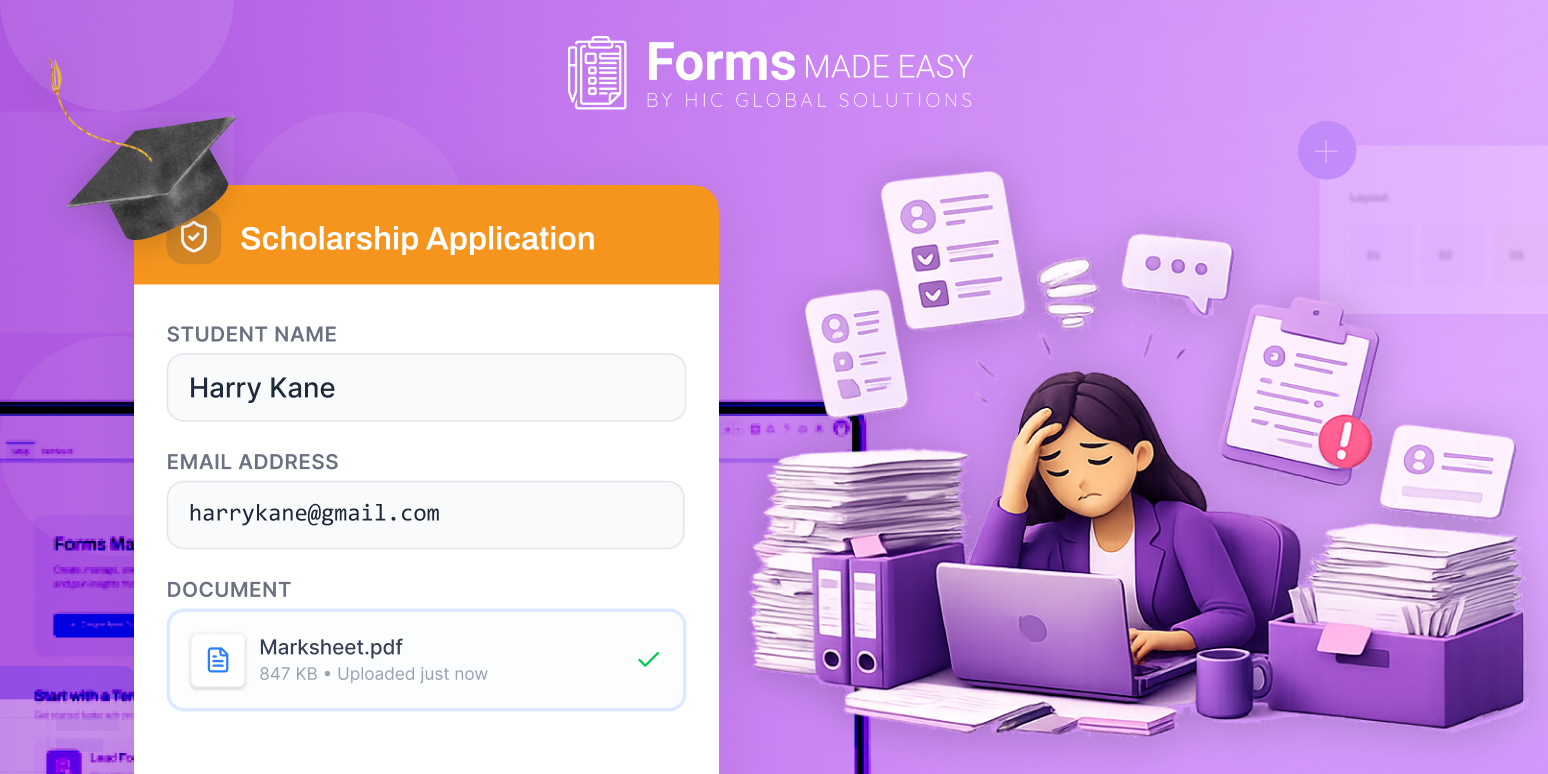
What appears to students as a simple scholarship form is usually connected to hours of manual verification, document coordination, approval tracking, and repetitive communication across admissions and financial aid departments.
In this blog, we will explore why scholarship application form workflows become difficult to manage during peak intake periods, the operational challenges institutions commonly face, and how connected digital processes help reduce administrative workload while improving efficiency.
How Scholarship Application Forms Create Administrative Challenges
Manual Verification Slows Down Scholarship Processing
One of the biggest operational issues institutions face is manually verifying every scholarship form submission individually.
Administrative teams often spend hours:
- Checking eligibility documents manually
- Reviewing incomplete application information carefully
- Validating uploaded academic and financial records repeatedly
- Following up for missing student documentation continuously
When thousands of applications arrive together, this process quickly becomes difficult to manage efficiently.
Even a well-designed scholarship application form template can create delays if verification workflows still depend heavily on manual coordination.
Teams Spend Too Much Time Following Up With Students
Many institutions still rely on emails and phone calls to complete missing information after students submit a scholarship form online.
That usually includes:
- Missing transcripts or identification documents
- Incorrect financial information submitted by students
- Incomplete recommendation or eligibility sections
- Unsigned declarations and consent confirmations
Instead of reviewing qualified applications faster, administrative teams spend large amounts of time chasing incomplete submissions manually.
Data Gets Scattered Across Multiple Systems
A major challenge during peak intake is disconnected operational systems.
Student information submitted through a scholarship application form often gets transferred manually into:
- Financial aid systems
- Student management platforms
- Internal spreadsheets
- Email workflows
- Approval tracking systems
This creates data silos and increases the chances of duplicate records or outdated student information across departments.
Even institutions using a scholarship form online sometimes continue managing approvals manually behind the scenes.
Application Review Workflows Become Difficult to Track
As application volume increases, institutions struggle to maintain visibility into where applications actually stand.
Teams often cannot easily track:
- Which scholarship form submissions are completed
- Which applications still need document verification
- Which students already received follow-up communication
- Which approvals are pending internally
Without centralized visibility, scholarship operations become harder to manage every intake cycle.
Administrative Burnout Increases During Peak Seasons
Peak intake periods create operational stress for admissions and financial aid departments.
Administrative teams often manage:
- High application submission volume daily
- Repetitive data entry across disconnected systems
- Constant applicant communication and clarification requests
- Spreadsheet-based tracking for scholarship approvals
- Last-minute verification and review coordination work
Over time, these repetitive processes create burnout and reduce operational efficiency across departments.
For institutions, operational efficiency during scholarship intake is what truly shapes the student experience.
Inconsistent Scholarship Workflows Create Delays
Many institutions still use separate workflows for different scholarship programs.
As a result:
- Some applications move faster than others
- Different departments follow different review processes
- Students receive inconsistent communication updates
- Approval timelines vary across scholarship categories
Without standardized workflows, scholarship application processing becomes inconsistent during high-volume intake periods.
Reporting and Decision-Making Become Less Reliable
Disconnected scholarship operations also affect reporting accuracy.
When scholarship application template workflows operate across separate systems, leadership teams struggle to track:
- Scholarship application completion rates accurately
- Student engagement across scholarship campaigns
- Approval bottlenecks slowing down intake operations
- Operational workload during peak application cycles
Without centralized operational visibility, institutions often make reactive decisions instead of proactive improvements.
How Institutions Can Simplify Scholarship Application Workflows
Modern institutions are now moving away from disconnected scholarship processing systems and manual review workflows.
This is where solutions like Forms Made Easy helps institutions simplify scholarship application management through connected digital workflows directly inside Salesforce.
Instead of managing disconnected spreadsheets, emails, PDFs, and manually updated systems, institutions can create smarter scholarship form workflows with centralized visibility and automation.
With Forms Made Easy, institutions can:
The platform also helps institutions improve operational coordination by centralizing student data, application tracking, approvals, and communication workflows inside Salesforce.
This helps administrative teams focus more on reviewing qualified applications instead of managing repetitive operational tasks manually.
Conclusion
Managing scholarship applications during peak intake periods becomes difficult when institutions rely on disconnected systems, manual verification, and repetitive administrative workflows. Even a simple scholarship form can create operational pressure when teams handle thousands of applications across separate platforms and approval processes.
Modern institutions are now simplifying scholarship application form operations through connected digital workflows and centralized visibility. Solutions like Forms Made Easy help teams manage scholarship form online processes more efficiently, reduce administrative workload, automate approvals, and improve operational coordination directly inside Salesforce.
Institutions looking to modernize scholarship operations and Salesforce form template can also install Forms Made Easy directly from Salesforce AppExchange to simplify connected application management further.