

Turn Forms Into Automated Workflows
Design dynamic forms, streamline operations, and eliminate repetitive manual tasks — all without code.
Talk to Our ExpertsBuild Smarter Forms Faster
Create no-code forms inside Salesforce and automate data collection, approvals, and workflows without complexity.
Get StartedSimplify Your Form Workflows
Replace manual processes with intelligent forms that capture, route, and manage data seamlessly in Salesforce.
Book a DemoIn 2026, the conversation around Salesforce form builders has changed in a noticeable way. Earlier, teams evaluated tools based on how quickly a form could be created or how many layout options were available. Today, the focus has shifted to something deeper. People want forms that understand Salesforce data, anticipate user intent, and quietly reduce effort without adding complexity.
This shift is especially visible in forms for Salesforce, where forms are no longer treated as simple data entry screens. They have become the starting point for automation, record creation, approvals, and even customer journeys.
This shift is part of the broader industry trend toward AI-driven automation and low-code/no-code development, which analysts report is now mainstream, with around 80% of IT organizations using low-code and no-code development tools to accelerate application and workflow automation.
Most of the Salesforce customers rely on custom objects and automation to run daily operations. Forms now sit right at the center of that activity.
What can be expected to change in 2026 is not just technology, but expectations.
The 2026 Shift: Salesforce Form Builders Are Thinking More, Showing Less
Modern teams are tired of busy interfaces. They don’t want to decide which field to show or hide every time a form is used. They want the form to already know.
That’s where today’s Salesforce form builder tools are heading. Instead of exposing various of configuration options, they focus on intelligence. Fields appear only when they’re relevant. Salesforce data fills itself in where possible. Users move through forms without feeling like they are “building” anything.
This is why forms for Salesforce in 2026 feel lighter. Not because they do less, but because they reduce user effort.
By 2025, Gartner predicted that 70% of new applications will be built using low-code or no-code development platforms. That single insight explains why simplicity now beats customization.
At a high level, teams now expect Salesforce form builders to:
- Understand Salesforce data models without manual configuration.
- Reduce repetitive input rather than redesigning layouts.
- Support automation and workflows from the first submission.
- Feel intuitive even for non-technical users.
Forms are no longer judged by how they look, but by how little friction they create.
AI Is Quietly Changing How Forms Are Created
AI in form builders isn’t about flashy features, in 2026, it’s subtle and practical.
Many Salesforce-focused tools now use AI-assisted logic to suggest field mappings, recommend layouts based on object type, or identify which fields are typically filled together. This doesn’t replace user control, it reduces guesswork.
In real-world usage, AI helps by:
- Suggesting relationships between Salesforce objects.
- Identifying redundant fields before a form goes live.
- Recommending layouts based on past usage patterns.
- Helping users avoid logic conflicts they might not notice.
In practical terms, this means a Salesforce form creation can guide users toward better structures without forcing decisions upfront. Forms adapt based on record type, user role, or previous data, creating a smoother experience that feels natural rather than engineered.
This is also where forms for Salesforce start to feel less like tools and more like workflows.
Templates Are No Longer Static, They’re Starting Points
One major development in 2026 is how templates are used. Earlier, templates were rigid. You picked one, adjusted it heavily, and hoped it still worked six months later.
Now, templates are flexible frameworks. Multiple templates are easier to manage, reuse, and adjust without rebuilding everything. Users expect to switch templates quickly depending on use case, onboarding, internal requests, surveys, or customer-facing forms.
This matters because Salesforce forms are rarely one-size-fits-all. Sales, support, operations, and HR all use forms differently. Modern tools acknowledge that reality.
This evolution has made forms for Salesforce more scalable across teams without multiplying maintenance work.
No-Code Is Now the Default, Not the Differentiator
In 2026, calling something a no code form builder is no longer impressive, it’s assumed. Business users expect to create, update, and deploy forms without involving developers for every change.
What has changed is the quality of no-code experiences. Instead of exposing complex rules, tools now guide users through decisions using plain language. Logic feels embedded, not bolted on.
This shift has made forms for Salesforce easier to manage long-term, especially in environments where processes evolve frequently.
Accuracy Matters More Than Speed
As automation increases, so does the cost of incorrect data. According to IBM, poor data quality continues to cost organizations trillions globally each year, and CRM systems are often where that data begins.
This is why intelligent pre-population has become essential. A well-designed prefill form reduces errors, improves trust, and shortens completion time. Users are more comfortable when they see familiar Salesforce data already in place.
For Salesforce-driven organizations, this directly impacts:
- Data Reporting Accuracy.
- Automation Reliability.
- Workflow Success Rates.
- Long-term Data Quality.
In Salesforce environments, this directly impacts reporting, automation, and downstream processes. That’s why forms for Salesforce are increasingly designed to protect data quality first, and aesthetics second.
Context Awareness Is Becoming the Default
Another intelligence shift that’s easy to miss is context awareness. In 2026, forms increasingly understand who is filling them out and why.
Context-aware Salesforce forms typically:
- Adjust required fields by role.
- Change language subtly for internal vs external users.
- Respect Salesforce permissions automatically.
- Adapt behavior based on how the form was launched.
A sales rep, a support agent, and an external customer may all interact with the same form logic, but the experience adapts quietly. Fields appear differently, language shifts slightly, and required inputs change based on role and permissions.
This kind of behavior used to require heavy customization. Now it’s increasingly built into how Salesforce forms operate. The form doesn’t announce that it’s being smart, it just feels like it’s paying attention.
The Role of Dynamic Behavior in Modern Forms
Users no longer expect long, static forms. They expect forms to respond to them.
A Salesforce dynamic form adapts as users interact with it: fields appear or disappear, sections adjust based on previous answers, and the experience feels conversational rather than transactional.
In Salesforce, this dynamic behavior is especially powerful because it aligns with record logic and business rules. When implemented well, it makes Salesforce forms feel intuitive even when the underlying data model is complex.
Smarter Defaults Are Replacing Validation Errors
Earlier generations of forms relied heavily on validation messages. Users filled out a form, clicked submit, and then had to fix multiple errors.
In 2026, intelligent defaults are doing more of that work upfront.
Instead of telling users what they did wrong, forms now suggest what’s likely right. Values are pre-selected based on record history. Common choices are surfaced automatically. Less common ones are still available but not pushed forward.
A well-designed prefill form doesn’t just save time; it builds confidence. Users trust the system more when it meets them halfway.
This has become especially important for forms for Salesforce, where data accuracy directly affects automation, reporting, and downstream processes.
Relationship Intelligence Is Quietly Doing Heavy Lifting
One of the most important but least visible improvements in 2026 is how form builders handle record relationships.
Modern tools now:
- Infer Parent–Child Relationships Automatically.
- Link Records Based On Launch Context.
- Prevent Common Relationship Errors.
- Reduce Duplicate Record Creation.
Salesforce data models are complex. Objects relate to each other in ways that aren’t always obvious to end users. Earlier form builders often exposed that complexity, forcing users to understand relationships they didn’t care about.
Now, intelligence sits in between.
Modern tools infer parent–child relationships automatically. If a form is launched from a specific record, the relationship is already understood. The user doesn’t need to select it again or worry about linking errors.
This is a major reason why Salesforce forms are being trusted more across departments. Fewer relationship mistakes mean fewer broken processes later.
A Quick Look at the Broader Form Builder Landscape
Across the market, many form tools now look similar on the surface. What separates Salesforce-focused tools is how deeply they understand Salesforce itself. Generic tools often struggle with object relationships, permissions, and automation triggers. That’s why forms for Salesforce remain a distinct category, requiring more intelligence than visual builders alone can provide.
Where Forms Made Easy Fits in 2026
Forms Made Easy reflects this 2026 mindset clearly. Instead of overwhelming users with configuration screens, it focuses on how forms behave inside Salesforce.
Supports multiple templates without making them hard to manage, respects Salesforce logic and object relationships, and reduces the effort required to build and maintain forms as processes evolve.
For teams using forms for Salesforce daily, this approach feels practical rather than overdesigned, which is exactly what most users want now.
Forms Made Easy is the perfect choice for the user looking for a quick form creation tool with no-code functionality and smart mapping. To understand it better, install it on App Exchange now and explore its capabilities with hands-on experience.
Final Thoughts
Form builders in 2026 are no longer about how fast you can drag and drop fields. They’re about how little effort users need to put in once the form is live.
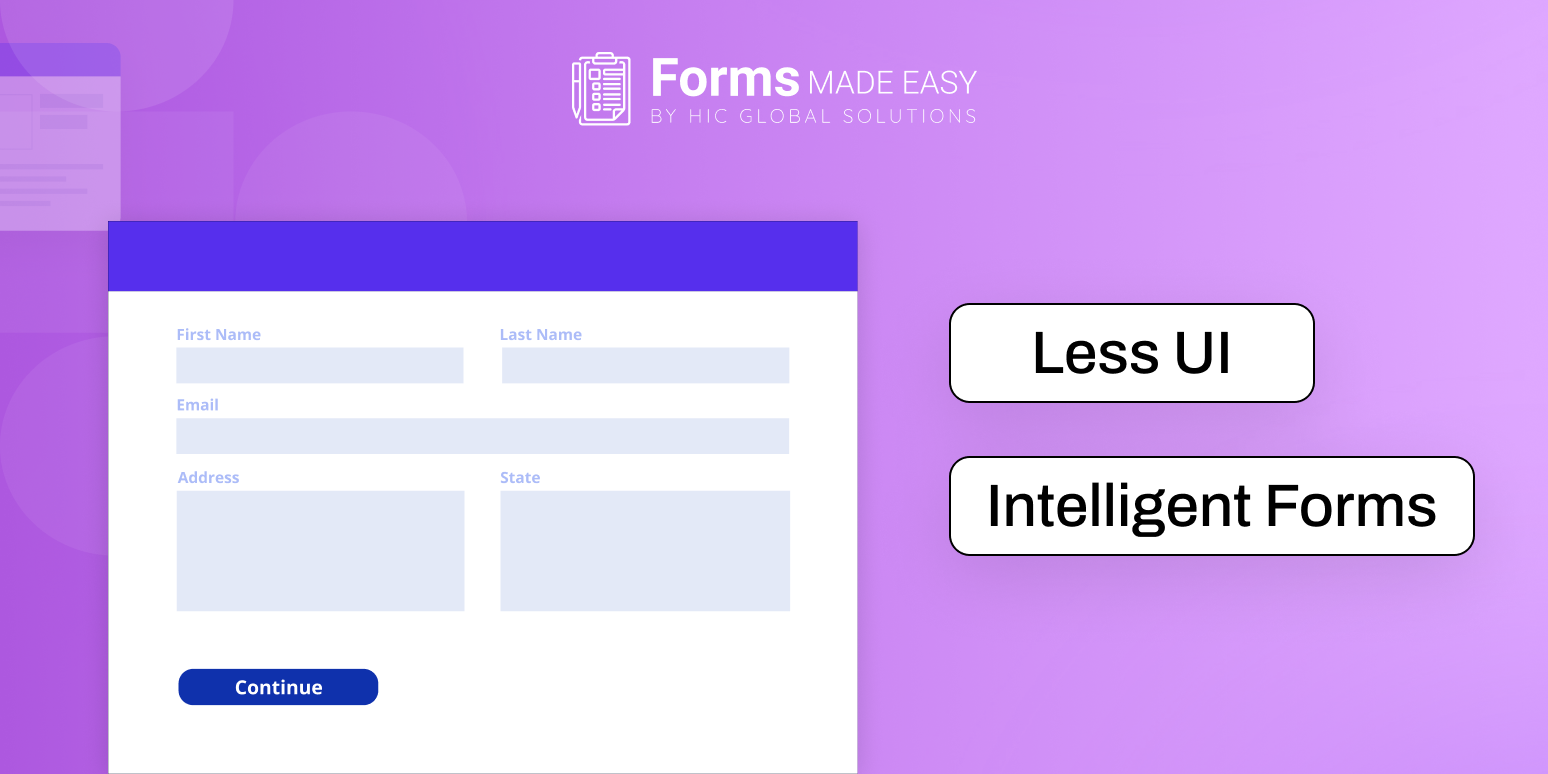
The move toward intelligence, AI-assisted logic, flexible templates, and minimal UI is not a trend; it’s a response to real usage patterns. As Salesforce continues to act as an operational backbone, forms for Salesforce must quietly support that role without adding friction.
So, the best form builders today don’t demand attention. They work in the background, adapt to context, and let users focus on their actual work. That’s what “less UI, more intelligence” truly means in 2026.